

The European Air Quality Index (EAQI) is calculated based on concentration values of up to five key pollutants:
- particulate matter (PM10)
- fine particulate matter (PM2.5)
- ozone (O3)
- nitrogen dioxide (NO2)
- sulphur dioxide (SO2).
This calculation involves several steps. First, data is collected from quality monitoring stations, providing hourly measurements of pollutant concentrations. Next, these concentration values are compared to predefined thresholds for each pollutant, determining which index band they fall into, ranging from ‘Good’ to ‘Extremely Poor’. The index level for each pollutant is then determined, with the highest index level among all pollutants measured at a particular station being selected as the overall index level. Health messages corresponding to the selected index level are provided for both the general population and sensitive populations. Overall, the EAQI provides a comprehensive assessment of air quality, enabling individuals and authorities to make informed decisions to protect public health and the environment.
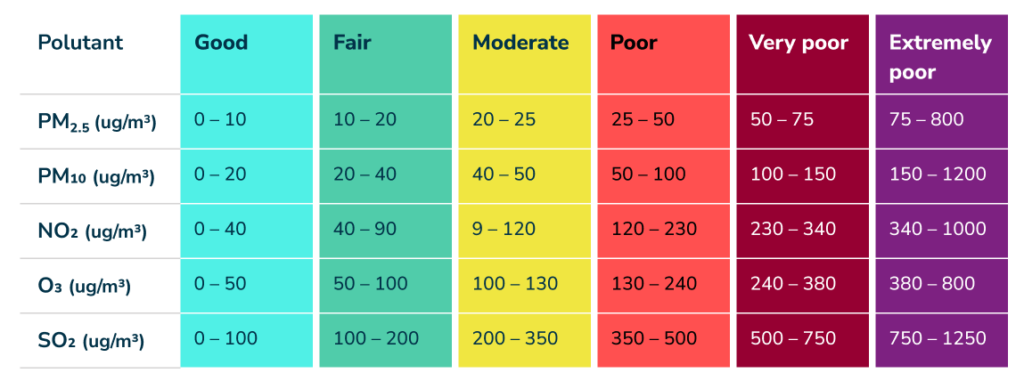
The colour scheme is provided to give information on the status of the air quality at each station.