

In air quality world, focus is often on the numbers – concentrations, indices, thresholds… But behind every data point lies a process that determines how much we can actually trust those numbers.
That process is calibration.
What is calibration?
In simple terms, calibration is the process of ensuring that a sensor measures what it is supposed to measure, accurately and consistently.
Over time, all sensors can drift. Environmental conditions, sensor aging, and exposure to pollutants can affect readings. Without proper calibration, even high-quality sensors can produce data that gradually becomes unreliable.
Calibration aligns sensor readings with known reference values, ensuring that measurements remain meaningful and comparable.
Why accuracy isn’t optional
Air quality data is increasingly used to form decisions, from urban planning and public health to building management and everyday behavior.
Small measurement errors can lead to very different interpretations:
- Is air quality improving or worsening?
- Are mitigation measures working?
Without reliable calibration, these answers become uncertain. In other words, data is only as good as the process behind it.
From measurement to trust
Reliable air quality monitoring is not just about collecting data – it’s about creating confidence in that data.
Calibration plays a central role in:
- ensuring consistency across devices and locations
- enabling meaningful comparisons over time
- supporting data-driven decisions with confidence
It transforms raw measurements into trusted insight: and that is the very difference between data you can rely on and data you simply collect.
Not all measurements carry the same weight. Without proper calibration and validation, numbers can look precise while lacking true accuracy.
In the end, it’s this distinction that defines the credibility of any air quality monitoring system, and where the differences between solutions on the market become truly visible.
Validated Across Borders
To confirm the reliability of Sensees monitoring stations across different environments, additional validation was carried out in collaboration with the Czech Hydrometeorological Institute (CHMI).
Sensees outdoor AQ monitoring stations were deployed alongside reference-grade instruments under real-world conditions, enabling direct comparison of measured values across key pollutants. The results once again demonstrated strong agreement with reference measurements, confirming consistent performance beyond a single location or project.
This independent evaluation reinforces an important point: accuracy is not a one-time achievement, but something that must be proven repeatedly – across geographies, conditions, and use cases.
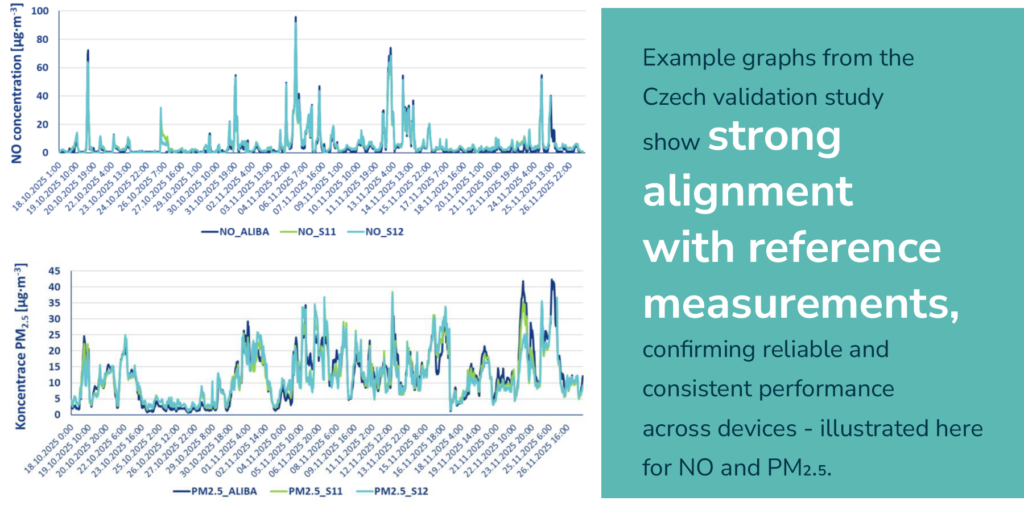
Together with previous validations, these results highlight Sensees’ commitment to delivering data that remains reliable, comparable, and trustworthy wherever it is deployed.
Tested and Verified by DHMZ
In Smart Sense this level of accuracy is not just theoretical – it has been validated in real-world conditions.
In collaboration with the Croatian Meteorological and Hydrological Service (DHMZ), eight Sensees outdoor monitoring stations were co-located with reference-grade instruments as part of the LIFE CityTRAQ project.
The results showed a high level of agreement, with the coefficient of determination (R2) reaching up to 0.99 for certain pollutants, demonstrating strong alignment with reference measurements. This was accompanied by single-digit inter-sensor variability across eight collocated units.
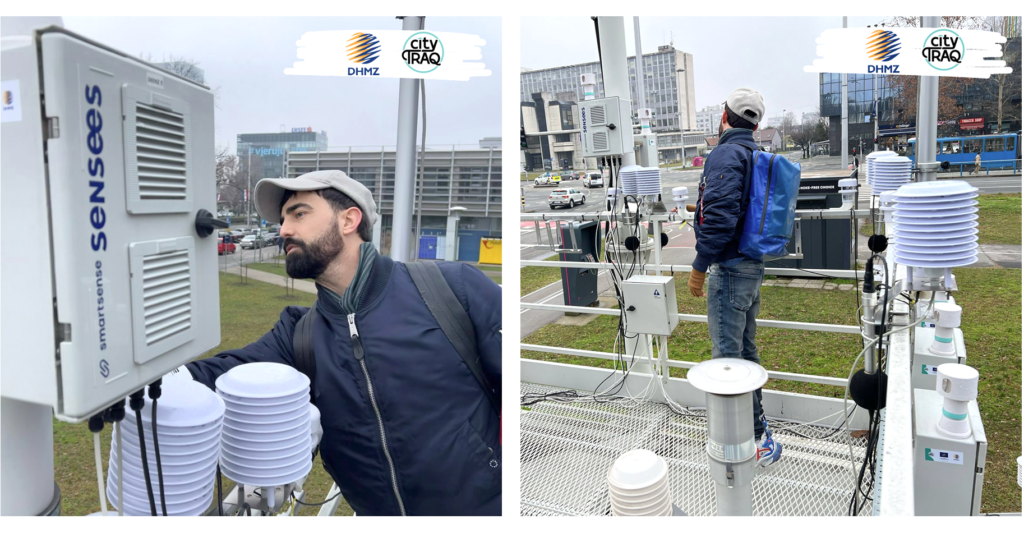
Testing of Sensees outdoor stations with DHMZ reference stations
This kind of validation is essential in distinguishing calibrated, reliable systems from those that only approximate air quality conditions. At Smart Sense, we are proud that Sensees Outdoor monitoring stations have demonstrated their data reliability through this validation process, and we remain committed to continuously improving accuracy, performance, and trust in every measurement we deliver.
Calibration in practice
A robust calibration process typically includes multiple steps:
- controlled laboratory calibration under known conditions
- validation and result processing
- outdoor or on-site calibration
- continuous monitoring and maintenance
Each step helps reduce uncertainty and improve data quality.
At Smart Sense, electrochemical sensor modules are calibrated and validated in our own laboratory, ensuring high accuracy and compliance with EU Directive 2024/2881 and and US EPA guidelines for environmental monitoring.
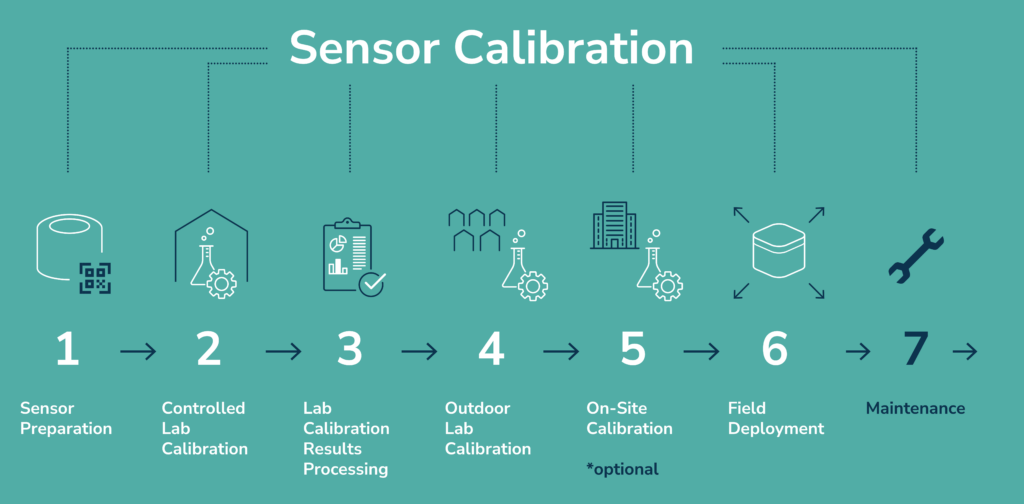
How calibrations works in Smart Sense
Having an in-house calibration lab allows us to maintain full control over the process: from initial preparation to final validation. This not only improves consistency and responsiveness, but also ensures that quality is not outsourced, but built directly into every device.
Calibration Is Not a One-Time Process
Calibration is not a one-time step – it is an ongoing requirement.
Scientific studies show that air quality sensors are subject to drift over time due to environmental exposure, sensor aging, and changing atmospheric conditions. Without regular recalibration, measurement accuracy gradually declines, even in high-quality devices.
Research indicates that recalibration may be needed as frequently as every few months, depending on usage and environmental factors. In practice, recommended recalibration intervals vary by technology.
Seasonal recalibration is recommended twice per year at locations where the station can be co-located with a reference unit. This can be performed remotely, without the need for a site visit, and is not mandatory. Sensees electrochemical sensors are replaced every two years in accordance with the maintenance program.
Continuous validation and maintenance are therefore essential for ensuring reliable and comparable data over time. In the end, this is what distinguishes short-term measurements from monitoring systems that can truly be trusted.
It also highlights the importance of choosing solutions that are supported by proper technical infrastructure, including access to recalibration, ongoing maintenance, and expert support. Because reliable data doesn’t depend only on the sensor itself, but on the system that stands behind it.
Why it matters more than ever
As air quality becomes part of everyday decision-making – not just for experts, but for cities, businesses, and citizens – expectations around data reliability are growing.
People don’t just want data.
They want data they can trust.
And trust doesn’t happen by accident.
It starts with calibration.