
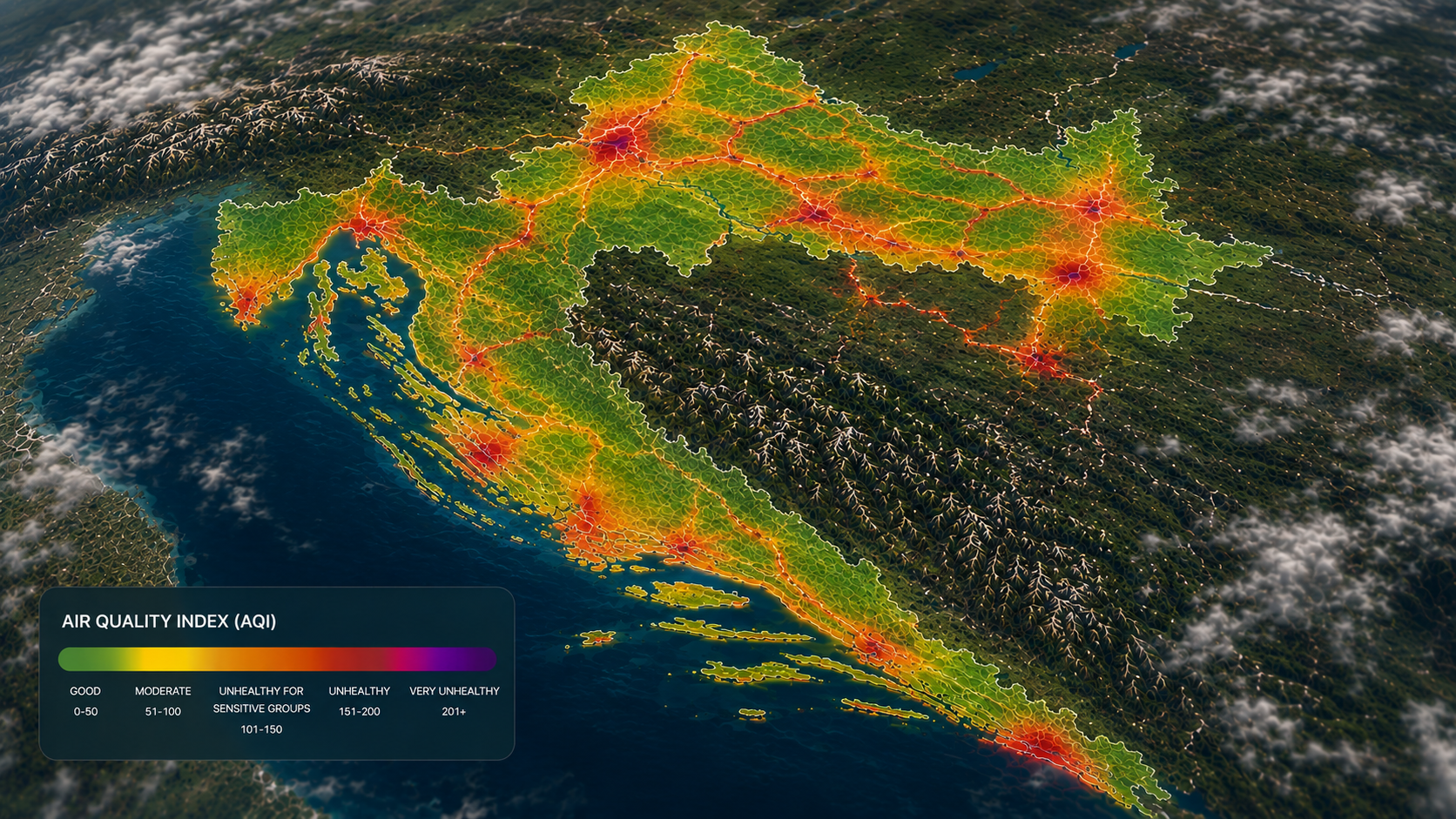
When we talk about air pollution in cities, traffic tends to take much of the blame. But data tells us the story is not quite that simple, and the answer to “What is actually polluting our air?” can change significantly depending on where we live and the time of year.
This time, we turned our attention close to home. With our roots in Croatia and years of experience working with environmental data, a new scientific study co-authored by our colleague Valentino Petrić takes a closer look at black carbon pollution across the country.
The study presents the first systematic multi-station analysis of black carbon sources in Croatia, using several years of measurements from locations spanning continental, sub-Mediterranean and Mediterranean environments. The research was carried out as part of the Horizon Europe NextAIRE project, with additional support from Next Generation EU through the Environ Pollut Health projects. You can explore the full scientific paper here, while below we’ve highlighted some of the findings that caught our attention and looked at what they tell us about the air around us.
First things first: what is black carbon?
Black carbon (BC) is produced by the incomplete combustion of fossil fuels and biomass. It is found in particles generated by sources such as road traffic and residential wood burning.
It matters for two major reasons: it affects human health and it influences the climate by efficiently absorbing solar radiation. And unlike PM mass concentration alone, multi-wavelength BC measurements can indicate where the pollution is coming from separating the traffic-related from the biomass-burning contribution, at hourly resolution and without offline chemical analysis.
And that is where things get interesting.
In winter, cars are not always the main culprit
The study analysed data from eight monitoring stations across Croatia, covering Zagreb, Osijek, Slavonski Brod, Rijeka, Split, Višnjan, Polača and Kopački rit. Together, they represent very different climates and emission environments – from the continental interior to the Adriatic coast.
The results reveal a clear divide between continental and coastal Croatia.
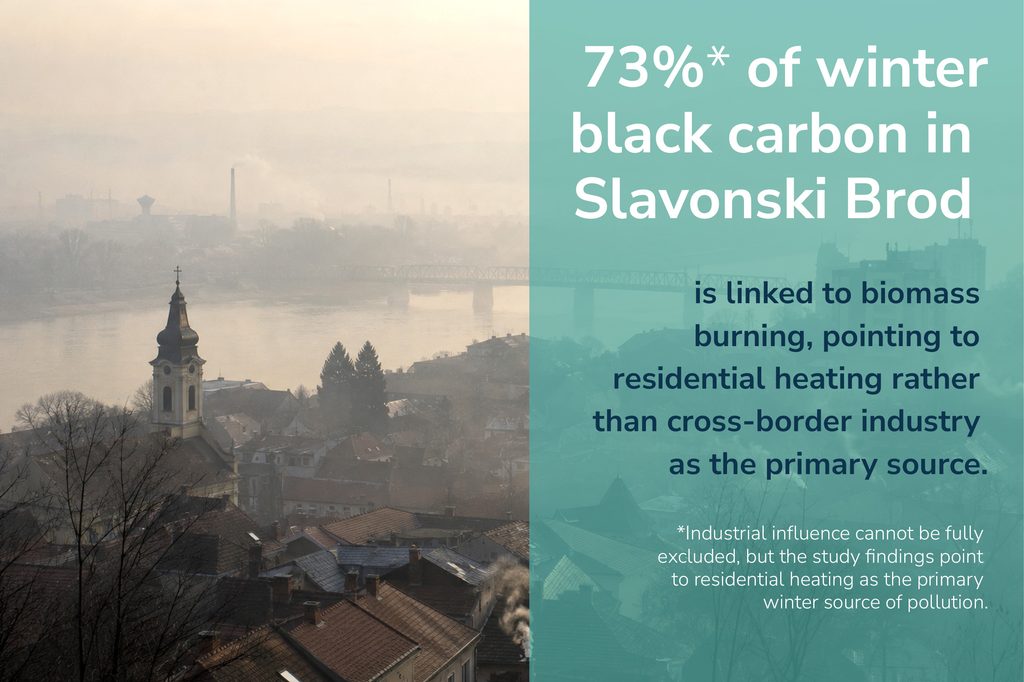
In Zagreb, Osijek and Slavonski Brod, black carbon concentrations rise significantly during winter, with most of that increase associated with biomass burning, primarily residential solid-fuel heating. During winter, the biomass-burning contribution reached around 62% in Zagreb, 68% in Osijek and as much as 73% in Slavonski Brod.
On the coast, it is a different story. Milder winters mean less demand for residential heating, leaving traffic as the dominant source throughout most of the year. Split stands out for its relatively weak seasonality – and even shows an increase in the traffic-related component during summer, consistent with increased road traffic during the tourist season.
Our air follows our daily routines
The data reveals another interesting pattern.
The traffic – related component of black carbon shows two very recognisable peaks during the day: between 7 and 9 AM and again between 5 and 7 PM. In other words, the morning and afternoon rush hours leave their signature in the air.
In winter, another signal appears. From around 4 PM, the biomass-burning component begins to rise, reaching its peak between 7 and 10 PM, consistent with residential heating during the evening hours.
In a way, air quality data reflects the rhythm of our everyday lives.
One problem, different solutions
Perhaps the most important takeaway from the study is that there is no single air quality solution that will work equally well everywhere.
For continental cities, the findings point to residential energy transition and cleaner heating as key priorities. In coastal cities, reducing traffic emissions becomes considerably more important.
To make better decisions, we first need to understand what is actually happening in the air – where, when and why.
And this is where long-term monitoring and reliable environmental data stop being just numbers on a screen and become a tool for making better, more targeted decisions.

Congratulations to Valentino and the entire team of authors on a study that gave us a great reason to bring the conversation about black carbon beyond the scientific community.
Authors:
Darijo Brzoja, Croatian Meteorological and Hydrological Service
Valentino Petrić, Smart Sense Ltd
Mario Lovrić, Institute for Anthropological Research
Nikolina Račić, Institute for Anthropological Research