
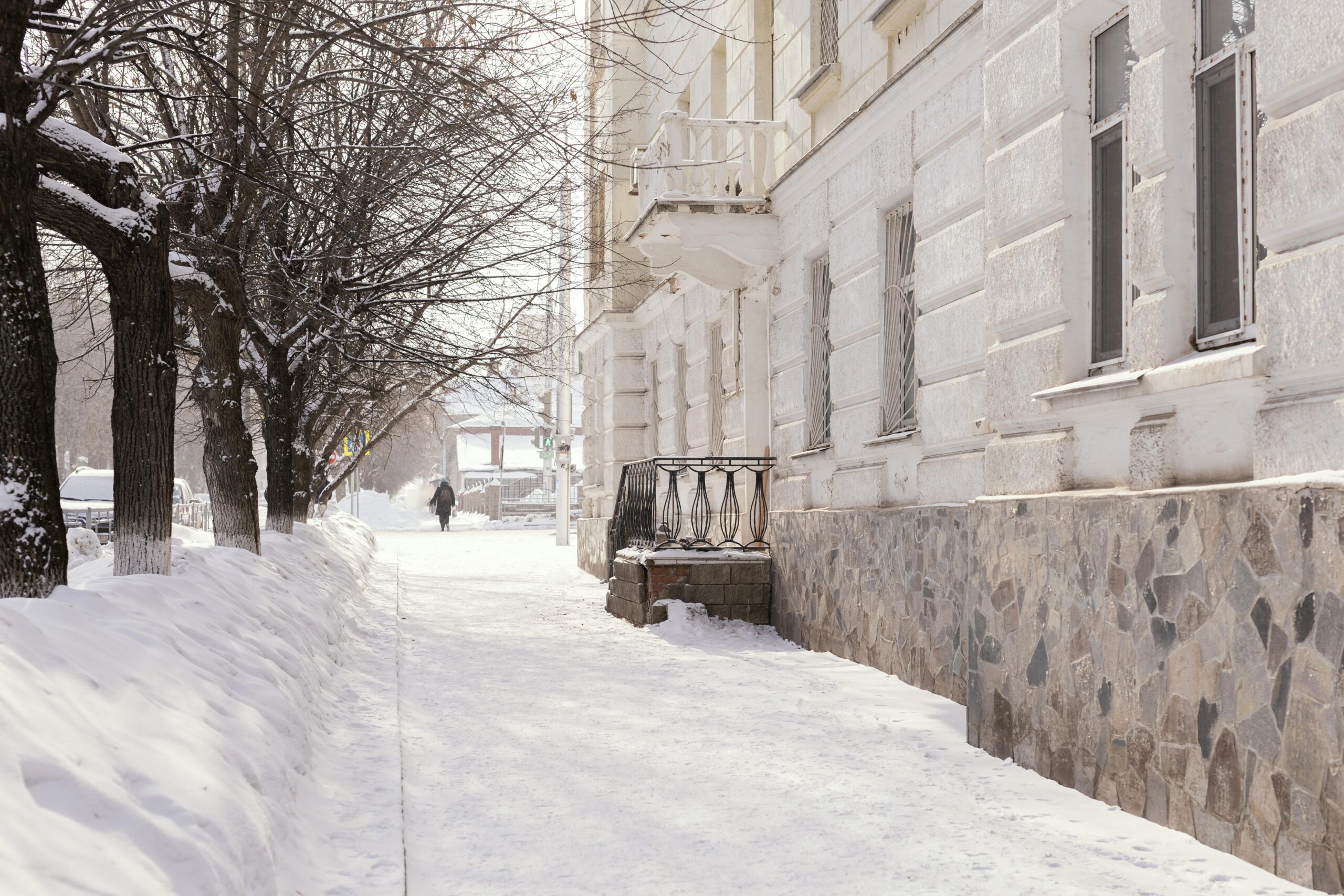
Snowfall often creates the impression of fresh, clean air. A white landscape, reduced noise, and a slower pace of everyday life easily led us to conclude that air quality has genuinely improved. However, experience and data show that reality is far more complex.
Although snowy days are often associated with cleaner air, sensor data reveal that air quality changes significantly through three distinct phases: before, during, and after snowfall. These changes are not always visible, nor can they be reliably assessed by our senses, but air quality sensors capture them with great precision.
At moments when everything appears calm and clean, the data often tell a very different story.
Before Snowfall: Quiet Tension
Just before streets are covered by snow, the atmosphere is often stable and calm. Air circulation is weak, meaning that cold air mixes poorly with warmer air, preventing the dispersion of harmful particles that remain concentrated close to the ground… where people breathe.
Under these conditions, sensors frequently record elevated levels of PM2.5 and PM10 particles, as well as other harmful gases, even when the sky appears clear and bright.
The air feels still, almost odourless… but beneath the surface lies an invisible tension that sensors clearly detect.
During Snowfall: A Short-Lived Renewal
When snow begins to fall, a natural phenomenon known as wet deposition occurs – a process in which precipitation captures airborne particles and brings them to the ground, temporarily cleaning the air. This is when outdoor monitoring stations often record a drop in particulate matter concentrations, and the air truly does become “cleaner,” but only briefly.
This is why the first snowflakes are often experienced as a moment of calm – at least until we have to clean them from cars or sidewalks. As we watch them fall from the warmth of indoors, everything seems quieter, slower, and cleaner at first glance, and sensor data often confirm that air quality does indeed improve temporarily at this stage.
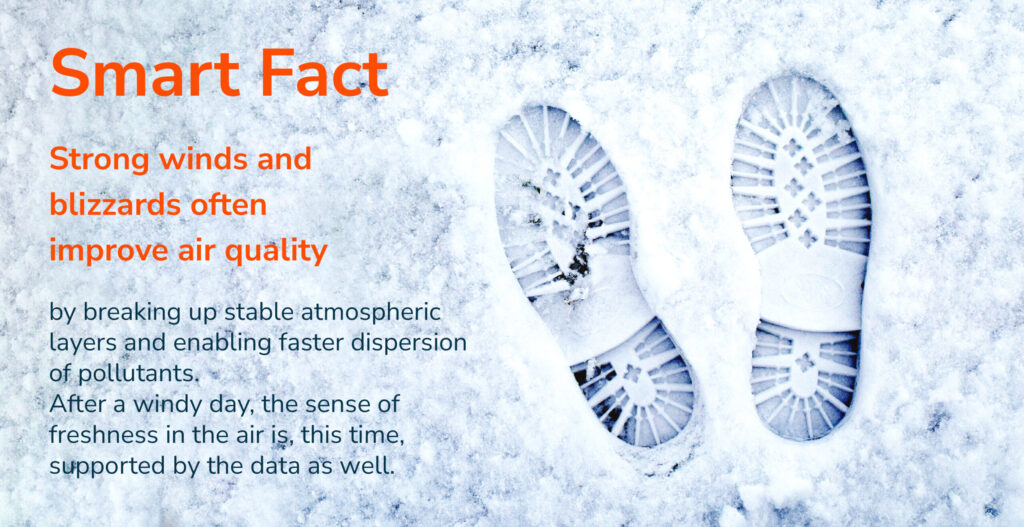
When snow combines with strong winds and turns into a blizzard, the air no longer remains still. Wind breaks up stable atmospheric layers, disperses pollutants, and often brings short-term relief – so even when the weather outside appears harsh, the air being measured can be cleaner than the day before.
After Snowfall: Reality Returns
Once the snow stops falling and the ground continues to crunch under our steps, the atmosphere often becomes stable and calm again, with little wind and weak air mixing – conditions that favour the accumulation of pollution near the ground. This is an ideal time for temperature inversion to occur. Cold air near the surface becomes trapped, while warmer air above acts like a lid.
Under these conditions:
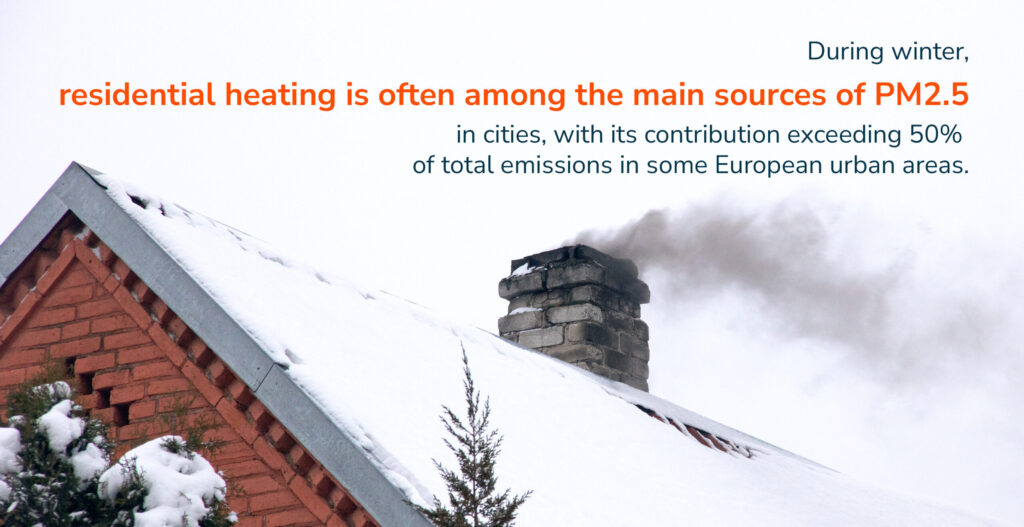
- households intensify heating,
- traffic returns to normal levels,
- pollutants remain “trapped” close to the ground.
Sensors once again record rising PM2.5 levels and other pollutants, which often contradicts the calm, clean impression seen through the window alone.
At first glance, it may seem that snow has cleansed the air, but reality is not quite so simple. Research shows that PM2.5 concentrations often decrease during precipitation, only to rise again after it stops and the atmosphere stabilizes, as pollutants remain in the lower air layer without sufficient dispersion – precisely due to weak air mixing and stable post-snow conditions.
Snow may cover the traces, but sensors remain objective witnesses to what lingers in the air.
Europe Under the Magnifying Glass: Milder Winters, the Same Measurements
Although studies on the impact of snow itself vary depending on local and climatic conditions, European institutions clearly emphasize the importance of monitoring and managing air quality year-round, including winter, when meteorological conditions strongly influence particle concentrations. This is especially important because fine particulate matter (PM2.5) remains a major health risk in cities and communities across Europe.
According to the European Environment Agency (EEA), in 2023 and 2024 nearly 92% of monitoring stations recorded PM2.5 concentrations above World Health Organization guidelines, even though many still comply with official EU limits.
At the same time, the EU is working to tighten air quality standards to better align with the latest WHO recommendations and reduce health risks associated with air pollution. This includes revising existing directives and introducing stricter annual limits for pollutants such as PM2.5.
Despite emission reductions over recent decades driven by regulation and cleaner combustion technologies, air pollution remains Europe’s leading environmental health risk and a major cause of premature deaths linked to respiratory and cardiovascular diseases.
This means that even in winter conditions, when snow can temporarily reduce particle concentrations, issues such as persistent emission sources, temperature inversions, and long-term exposure to PM2.5 remain critical for air quality and public health.
Looking at Sensors Is Still More Reliable Than Looking at the Sky
Snow can temporarily, and deceptively, “wash” the air, but that is only part of the story.
Sensor data show that air quality pulses with precipitation and in the period that follows, and that what we feel is not always what our lungs are actually breathing.
As city lights reflect in snowflakes and footsteps crunch on the ground, the values measured by sensors remain the quietest yet most reliable storytellers, helping us understand the invisible air we breathe throughout the entire year.
The content of this blog is prepared based on available scientific research, relevant expert sources, as well as sensor data, including internal analyses based on measurements, and is intended for informational purposes only.